
Forestry and Landscaping
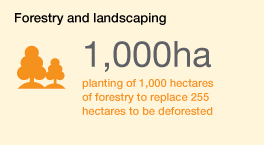
Under the Project plan 500 hectares of land would be redesigned and existing contamination and main pollution sources treated. After mining, three pits would be restored and revegetated and a lake of approximately 24 hectares would be created in one of the old pits.
Post mine closure all the affected areas in Rosia Montana would be reconstructed and the natural local flora and fauna reinstated via green "ecological corridors". Our plans include progressive environmental reconstruction and further measures to mitigate the impact on soils including fertilisation and conservation of the top soil, monitoring and treatment of acid soils, as well as environmental rehabilitation of the soil profile.
Water
As a result of Ceausescu era mining activities, the river waters in the area currently suffer severe heavy metals pollution many times higher than permitted under Romanian law (110 times the legal limit of Zinc; 64 times the legal limit of Iron; and 3.4 times the legal limit of Arsenic). The contamination runs up to 40km downstream from the site due ongoing erosion of historic workings.
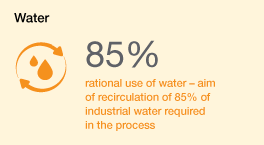
The Project could provide an immediate solution, cleaning water discharges, and meeting the high standards of the EU Water Framework Directive to allow the reintroduction of aquatic life.
Tailings Dam Safety
The Rosia Montana mining plan creates four open pits workings which could be remediated on an ongoing basis during the life of the Project. During processing the mined ore is leached using conventional carbon-in-leach technology. Gold is recovered through safe and modern cyanide technology, the process currently used to obtain more than 90% of gold production worldwide.
Click here to find out more about cyanide usage in mining and other industries.
The Tailings Management Facility (TMF), the system to handle processed waste rock, was designed by a team of international experts that included the former President of the International Commission of Large Dams – (ICOLD). They considered, quantified and analysed all scenarios over the full life cycle of the Project and created design and control measures to prevent potential tailings and water spillages.
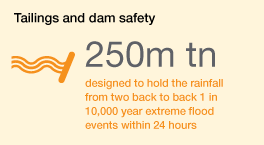
The TMF would feature approximately 20% excess capacity and be able to withstand both extreme weather conditions (for example two consecutive 1 in 10,000 year rainfall events within 24 hours) and earthquakes of magnitude eight on the Richter scale.
Other design and control measures include:
- A close circuit processing plant using special concrete tanks for cyanide. The tanks have an excess spill capacity of 110%;
- Process tailings treatment to reduce cyanide content to a concentration that is significantly below the level established by EU/Romanian legislation (10 ppm);
- Recirculation of water from the dam. with dam waters complying with the quality standards established for surface waters;
- A second containment dam to capture and contain any possible seepage from the main dam. Water quality monitoring systems will be downstream of the main and secondary containment dam;
- Maintenance of dam water between 9 to 11ph to ensure an alkaline environment.
Noise and Vibration
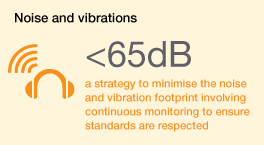
Noise and vibration would be low impact even in the industrial areas, and well within the limits required by legal standards. A strict curfew will prohibit operations during anti-social hours in the proximity of inhabited areas and noise dampening protection barriers would be pre-installed on machines. All noise and vibration would be subject to continuous monitoring.